Соотношение концентрации пены для снижения поверхностного натяжения воды для тушения пожаров
The ratio of foam concentration to reduce the surface tension of fire extinguishing water
- 1 Институт пожарной безопасности Вьетнама
С использованием специализированного оборудования экспериментально определено оптимальное соотношение концентраций пены для снижения поверхностного натяжения воды для тушения при тушении пожаров хлопка, тканей и других подобных материалов.
The optimum concentration ratio of foam was experimentally determined to reduce the surface tension of water for extinguishing while extinguishing cotton, fabrics and other similar materials, using specialized equipment.
Fire fighting in garment factories is complicated because of several factors: large area of fire; presence of many fire products containing toxic substances; insufficient firefighting water supply; large amount of time needed
to control and completely extinguish the fire. In textile factories, combustibles are mainly comprised of cotton, fabrics, fibers, etc., being packed in packages, bulks or lots. Fires involving cotton, cloth, fibers are usually characterized
by smoldering combustion within the core of cloth rolls or cotton bales.
When water is discharged into the fire, it is hard for it to penetrate inside because of its strong surface tension, thus hindering firefighting.
In the world, additives are added into water to reduce the surface tension of the water and increasing its permeability such as Cetyl-trimethylamino bromide (CTAB), soap, natrium laureth sulfate (SLES); dodecyl dimethylamine, dodecyl betain, dodecyl dimetylamin, cocamidopropyl betain, coco ampho glycinat, … However, due to their high cost, they cannot be used in large quantities to extinguish fires. To reduce the surface tension of water, the foam concentration “BP4CO2-H57”, which is produced in Vietnam, is used. This type
of foam concentration has similar properties to PO1, which is made in Russia. Some basic characterisitics of this foam concentration are as follows: the mixing proportion: 6 %; expansion ratio ≥ 6,5; time of degradation half-life ≥ 5 minutes; the pH: 6,5-7,5 [1].
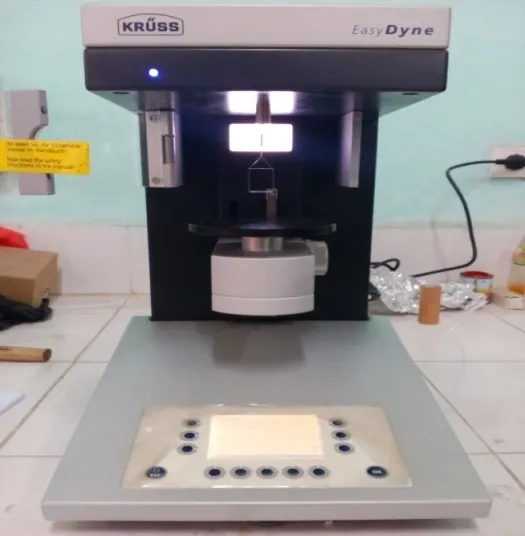
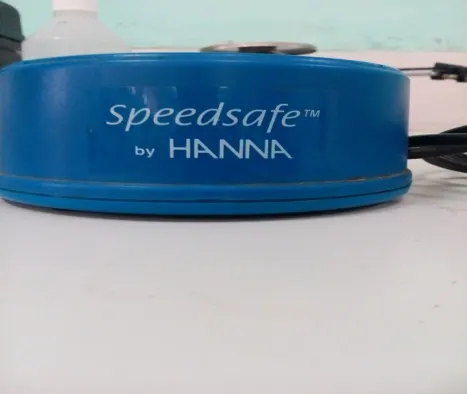
In order to determine the optimal ratio when mixing foam concentration into water, it is necessary to use the surface tension meters Easy Dyne (image 1) and magnetic stirrers Hanna HI180F-2 (image 2) to mix the foam concentration with water at a determined rate [2].
|
|
Image 1. Surface tension meters | Image 2. Magnetic stirrers |
After mixing the foam concentration with water at the ratio of 0,1-3,0 %, the surface tention ratio is measured five times using the surface tension meters. Variations in measured results are shown in the chart of changes in surface tension of firefighting water when being mixed with the foam concentration (see figure 1).
It can be seen that the variability of these changes is uniform and in non-linear form. The lowest value of surface tension coefficient, correlating with the proportion of foam concentration is 1,2, reducing the surface tension of water from 70 mN/m (at a temperature of 25 °С) to 27,7 mN/m.
Surface tension, mN/m |
|
Foaming agent, % |
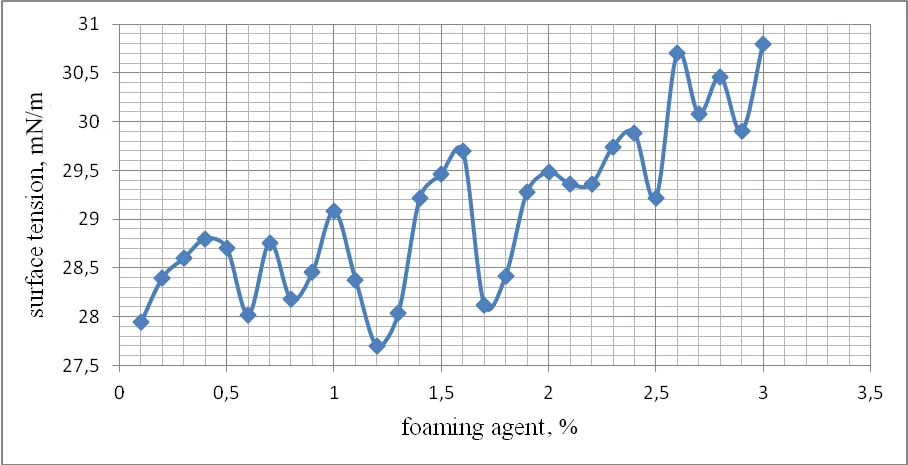
Figure 1. Surface tension change in correlation with foam concentrate proportion
The method of mixing foam concentration at the rate of 1,2 % is completely feasible and it can be applied directly in suppression of fires in which
it is difficult for water to diffuse into the burning substances due to the influence of firefighting water’s surface tension. In order to mix at this rate, it is only required to accurately measure the volume of the foam concentration solution, and to pour it into the water tank, then discharg on the fire. As the result, water will be absorbed into the packages of cloth, cotton and fabric, enhancing the efficiency in extinguishing fires as well as saving fuel used for motorized fire-fighting apparatuses.
References
1. Specifications of the foam concentration "BP4CO2-H57". Ministry of pulic security of Vietnam.
2. Instruction documents of Surface tension meters Easy Dyne and Magnetic stirrers Hanna HI180F-2.