Обоснование мест дислокации оперативных подразделений пожарной охраны на территории населённого пункта
Justification of the locations of the operational divisions of the fire brigade on the territory of the settlement
- 1 ФГБОУ ВО Академия государственной противопожарной службы МЧС России
Рассмотрен алгоритм обоснования мест дислокации оперативных подразделений пожарной охраны на территории населенного пункта. Данную задачу можно рассматривать как задачу определения оптимального числа пожарных депо и места их дислокации на территории населенного пункта.
The algorithm of substantiation of the locations of the operational divisions of the fire brigade on the territory of the settlement has been reviewed. This task can be considered as the task of determining the optimal number of fire stations and their place of deployment in the territory of the settlement.
When
designing the fire service garrisons of populated areas, it is
necessary to determine not only the required number, but also the
corresponding locations of the operational fire brigade units in the
territory of the populated area. Since the operational units are
located in the buildings of fire stations,
this task can be
viewed as the task of determining the optimal number of fire stations
and the place of their deployment in the territory of the settlement.
The
optimization criterion in this case is minimization of the total
number of fire stations in the territory of the settlement. Thus, for
each fire station
it is necessary to determine the service area
on which a certain set of buildings
is located (objects of
protection). At the same time, it is required that the total number
of fire stations in the whole locality should be minimal, and each
object of protection should be included in the service area of one of
the operational fire brigade units.
Depending
on the fire hazard of the object of protection and the purposes of
the duty guard’s fire, each object of protection corresponds to the
maximum allowable distance – ln
where n is the number of the object of protection. At this distance
should be deployed operational fire department. As mentioned earlier,
if, as a result of the calculations, it is obtained that ln
is 0.5 km, then it is decided by the
object that an object unit of fire protection should be created on
it. Figure 1. shows a conditional example of determining the location
of fire stations
by distance ln.
Object
1, 2, 3, 4 – possible locations of buildings
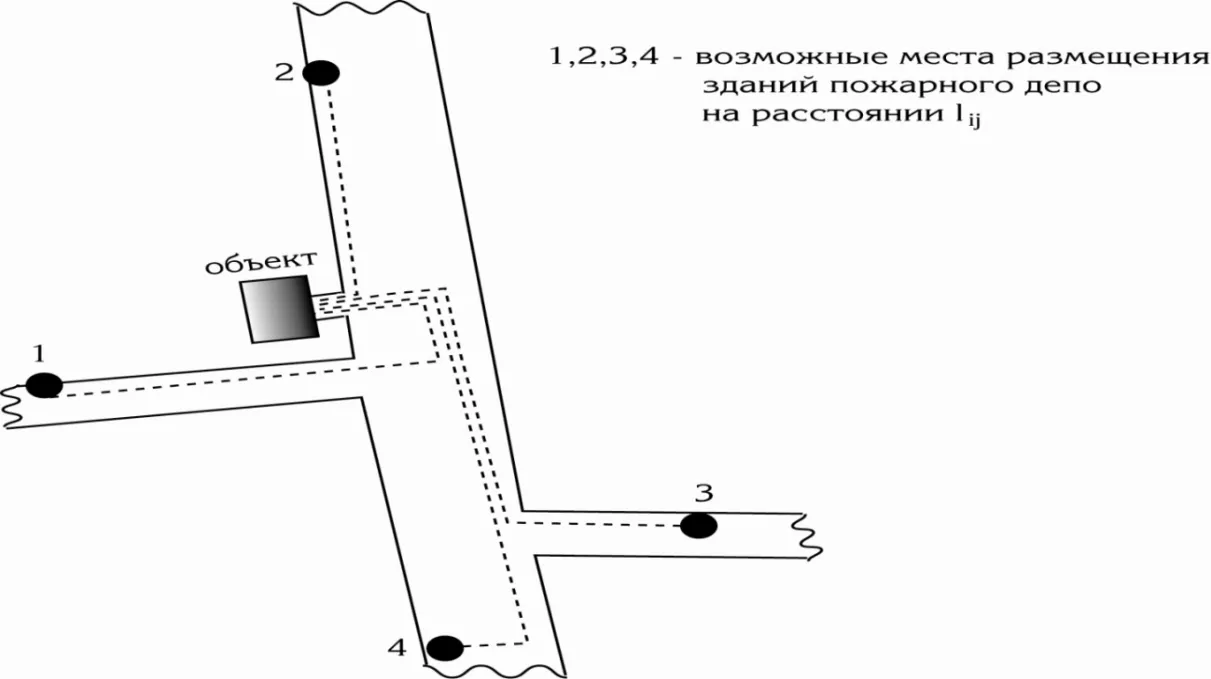
of the fire station at a distance
ln
Fig. 1. Conditional example of the location of the
building of the fire station
at a distance ln from the
protected object
Based on the value of ln for each object of protection in the territory under consideration, a spatial zone is defined in which the fire station building should be located. Depending on the numerical values of ln spatial zones, the corresponding objects of protection may intersect with each other. The area of intersection of spatial zones is considered as the place where the building of the fire depot should be located, serving the protection objects that formed the area of intersection.
The
above formulation of the problem belongs to the class of objects
placement problems (in our case, fire station buildings) using
discrete solution space. As variables in the tasks of integer
discrete programming, the values
0 and 1 are used. Methods for
solving these problems refer to enumeration methods and include
so-called "partitioning algorithms".
On the basis of discrete programming methods, a mathematical model and an algorithm for computing the solution of the problem of determining the locations of fire stations in the village have been developed. The description of this model and algorithm is given in the works [1, 2].
Let the number of objects of protection on the territory of the settlement be equal to N. For each object, the maximum allowable distance ln, on which the fire depot should be located, is determined in order to guarantee the fulfillment of the goals set for the guard on duty. Based on the value of this distance for each object of protection in the territory under consideration, a spatial zone is determined in which the fire station should be located, the so-called "coverage" zone of the object. The "coverage" zones of different objects can intersect with each other, forming the area in which the fire depot building should be located to provide fire protection of the objects, the "coverage" zones of which formed this intersection area. The region in which the "coverage" zones of two objects intersect will be called the 1st order intersection region. Accordingly, the region in which the "coverage" zones of n objects intersect will be called the intersection region of order n-1. It is necessary to determine the number and locations of fire stations in such a way as to ensure the fire protection of all objects of this settlement and the total number of fire stations was minimal.
Input information for the calculations are the following data:
Coordinates of buildings (structures) (hereinafter – the object of protection);
Calculated for each object of protection the maximum distance to the fire station ln;
Characteristics of the sections of the attributed transport network of the settlement (the length of the section, the speed of movement on the section of the vehicle, depending on the time of year and time of day);
Season;
Times of Day;
List of sections of the transport network temporarily closed for travel.
Литература
1. Матюшин А.В., Порошин А.А., Бобринев
Е.В., Кондашов А.А., Матюшин Ю.А. Модель
обоснования мест дислокации оперативных
подразделений пожарной охраны на
территории населенного пункта // Матер.
XX междунар. науч.-практ. конф.
"Исторические
и современные аспекты решения проблем
горения, тушения и обеспечения безопасности
людей при пожарах". Балашиха.: ВНИИПО
МЧС России, 2007.
С. 66-71.
2. Матюшин А.В., Порошин А.А., Бобринев
Е.В., Олейник С.А.,
Матюшин Ю.А.
Методология обоснования необходимого
числа оперативных подразделений пожарной
охраны для защиты населенных пунктов
от пожаров и численности противопожарной
службы субъектов Российской Федерации
// Юбилейный сборник трудов ВНИИПО МЧС
России: Балашиха: ВНИИПО МЧС России,
2007. С. 373-396.
3. Ngo Quang Toan. The model and algorithms
of the support system for resource management of operational
departments of the fire protection of large cities in Vietnam:
thesis for the degree of candidate of technical sciences.
Moscow, 2016.