Комплексное моделирование территориальных пожарных рисков
COMPLEX MODELING OF TERRITORIAL FIRE RISKS
- 1 Академия ГПС, МЧС России
- 2 ФГБОУ ВО Академия государственной противопожарной службы МЧС России
- 3 мгту им. н.э. баумана
Описана новая модель оптимального территориального распределения комплексных ресурсов противопожарной службы по однородным кластерам Вьетнама. В качестве примера применён комплексный удельный показатель, учитывающий как погибших, так и травмированных на пожарах. Целевая функция проблемного решения создана, используя принципы теории активных систем.
A new model of optimal territorial distribution of complex resources of fire service between homogeneous clusters of Vietnam is described. As an example, a specific complex indicator is used, taking into account both the number of dead and injured in fires people . The objective function of the problem solution is constructed using the theory of active systems principles.
A sufficiently fruitful scientific concept, which describes the activity of fire service system as "processing" of variables input vector into a specified output vector of results in accordance with a specific operational and service "technology" using necessary quantity and quality of human resources is proposed and justified in this paper [1, 2, 4, 5].
Relationship of specific index (attributable per one firefighter) for the number of deaths in fires (SIDF) with specific load by fires (SLF) is considered. This dependence is well described by the following exponential curve (explanability, i.e., squared correlation coefficient is equal to 73 %):
d = 0,33·exp(107,23·h). (1)
High explanability (76 %) characterizes empirical relationship of the specific index for the number of injuries in fires (SIIF) with specific load by fires (SLF), which is described by the exponential curve.
w = 0,31·exp(90,3·h). (2)
A complex specific indicator that takes into account both deaths and injuries in fires is formed, as is shown below:
 ·
 ,
(3)
where k =1, 2, …, K – the number of observation points (years),
K – the total number of years of observation equal to 10 years;
 weight
of the specific indicator
 ;
 weight
of the specific indicator
 .
The amount of weighting coefficients is constrained:
 (4)
The problem of finding weighting coefficients α, β and model parameters was set as follows:
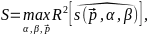 (5)
where S
– the value of the functional calculated as a maximum of the
explanability coefficient by varying model parameters
( – the vector) chosen from
the class of exponential curves and
weighting coefficients α and β
with constraint (4).
Real data calculations have shown that the best model for Vietnam is formed as follows:
s = (0,555·d + 0,445·w) = 0,318·exp(101,04·h). (6)
Maximum
value of the explanability coefficient is equal to 82 %
for
α = 0,555 and β
= 0,445.
Figure
1 shows empirical data and theoretical description of the
relationship between the complex specific indicator "s"
and SLF in Vietnam
in 2006-2016.
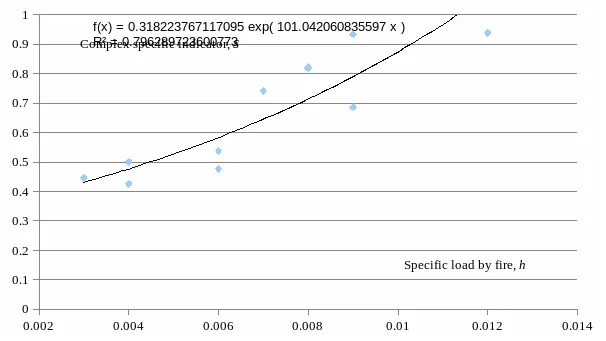
Fig. 1. Empirical data (diamonds) and theoretical
description (solid curve)
of the relationship between the
complex specific indicator s and SLF
in Vietnam in 2006-2016
The task of identifying territorial clusters that are homogeneous in complex fire risks in relation to Vietnam was solved in [3], using its results.
Based
on the results of the paper [1, 2], let’s introduce the target of
function
 ,
which reflects effectiveness of the use fire service's resources.
With regard to the k-th cluster in Vietnam, let’s write it as
follows:
φk=
φk
(Fk,
Rk, ),
(7)
where Fk – the number of fires in the k-th territorial cluster,
Rk
– the number of firefighter in the k-th
cluster,
the parameters' vector of target function in the k-th
cluster.
Let’s assume that the target function (7) grows monotonically in the range of 0 < Rk < ∞, that is, the more human resources is provided to the fire service in the cluster, the greater the target function, and
φk(Fk,
∞, )
= Ak
= const,
(8)
i.e. the function is limited from above.
The
target function of the general system of fire service in Vietnam Фц
is determined by the target functions of its units in clusters
and is written as the sum of them:
Фц
= .
(9)
Having limited human resources the center seeks to achieve optimal value of its system target (general target function) by defining target functions of active elements (fire services in clusters) by choosing such a distribution of human resources that stimulates them to improve ways and methods of operational activities in extinguishing fires, intensifying the use of available human resources.
The
task of distribution of human resources with known dependence φk
(Fk,
Rk,
)
and known parameters γk
is set as the following optimization target
Фц=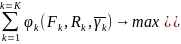 (10)
with the restriction in the number of human resources at the Center’s disposal:

 .
(11)
The principle, which is implemented in the formulation of the task of distribution of fire service's human resources in clusters, is the principle of optimal distribution.
Let’s consider analytical dependence (6) reflecting the relationship between specific load by fires and complex specific indicator by weighted number of deaths and injuries in fires to form the target function:
sk = 0,318·exp(101,04·hk), (12)
where the hk is the number of fires per firefighter in the k-th cluster.
It is evident that the problem of optimal distribution of human resources in clusters should be set so as to minimize the amount of quantities (12) throughout all k = 1, …, K; or to maximize the amount of their reciprocal values:
1/sk =3,145·exp(-101,04·hk). (13)
Let’s then define the target function:
 ·[1
– exp(-101,04·hk)]
≈3, 2·[1
– exp(-100·
 ],
(14)
which has the following graphic view (Figure 2).
It
is not too difficult to see that the function (14) increases
monotonically, and at
 .
Expanding
(14) in the Maclaurin series, the target function of the Center
is
represented as follows:
Фц
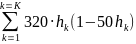 (15)
The problem of optimal distribution of human resources between the K clusters is set as follows:
 ,
(16)
 (17)
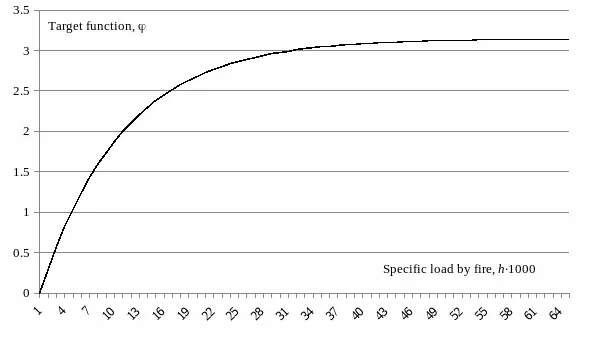
Fig. 2. The target function by complex specific
indicator of the number
of fatalities and injuries in fires
depending on the fire specific load
The task (16)-(17) is solved by using Lagrange multipliers method.
The Lagrange function is written as follows:
L(Фц)
=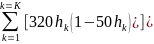 –
 (

 ,
(18)
where λ – the Lagrange multiplier.
The paper [1] shows that by differentiating (18) we obtain a cubic equation of optimal solution of which is as follows:
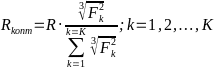 .
(19)
Computational experiments showed that using method of optimal distribution of human resources in accordance with (19) would reduce a complex specific indicator by about 10-12 % as compared to the current situation of their distribution in cluster.
The main conclusions from the formulation and solution of the problem of complex modeling of territorial fire risks are shown as the following.
1. Optimal ensuring of human resources is one of the central tasks, which is related to management of fire service in Vietnam. Finding a solution to this problem is directly related to improving the fire situation in all sectors of the economy, including the construction sector. Representation based on the approaches of theory of active systems [2], process of operational and service activity of fire service's personnel subsystems in clusters in terms of “input – human resources – output” and formal description of “operational and service technology” in fire service's activities turned out to be very constructive for the solution of this problem.
2. With regard to description of the management model of fire service's human resources in clusters in general, it is necessary to solve the task of multi-vector optimization. A special target function is constructed in this article, which is based on stable dependence of complex specific indicator of the number of deaths and injuries in fires per one firefighter with specific load by fires.
3. Computational experiments have shown that using the methodology of optimal distribution of human resources would reduce the specific complex indicator of the number of deaths and injuries in fires by about 10-12 % in the comparison with the current situation of their distribution in clusters in Vietnam.
4. Further development of the proposed approach is associated with an integrated:
- development of the presentation of fire risks in territorial clusters;
- quantitative and qualitative description of fire service resources;
- investigation of the impact of resources on fire risks;
- representation of the results obtained in the information-analytical system of monitoring and fire management.
References
1. Дао Ань Туан, Минаев В.А., Топольский Н.Г., Фаддеев А.О. Пожарные риски. Типологизация территорий. Управление ресурсами: монография. М.: Академия ГПС МЧС России, 2018. 251 с.
2. Бурков В.Н., Новиков Д.А. Как управлять проектами: научно-практическое издание. М.: СИНТЕГ-ГЕО, 1997. 188 с.
3. Минаев В.А., Топольский Н.Г., Дао Ань Туан. Типологизация территорий Вьетнама по характеристикам пожарной опасности // Пожары и чрезвычайные ситуации: предотвращение, ликвидация. 2018. № 1. С. 72-76.
4. Минаев В. А., Топольский Н.Г., Чу Куок Минь. Управление пожарными рисками на основе теории активных систем // Пожары и чрезвычайные ситуации: предотвращение, ликвидация. 2014. № 4. С. 59-65.
5. Jennings C.R. Social and economic characteristics as determinants of residential fire risk in urban neighborhoods: A review of the literature // Fire Safety Journal. 2013. No 62. Part A (0). Pp. 13-19.